<?xml version="1.0" encoding="utf-8"?><feed xmlns="http://www.w3.org/2005/Atom" ><generator uri="https://jekyllrb.com/" version="3.10.0">Jekyll</generator><link href="https://www.winkeylab.work/feed.xml" rel="self" type="application/atom+xml" /><link href="https://www.winkeylab.work/" rel="alternate" type="text/html" /><updated>2026-11-21T01:16:15+08:00</updated><id>https://www.winkeylab.work/feed.xml</id><title type="html">Winkey’s Lab @HK</title><subtitle>Memory Formation &amp; Consolidation</subtitle><author><name>CHENG, Wan Kiu Winkey</name><email>wkwcheng4-c@my.cityu.edu.hk</email></author><entry><title type="html">How Tsinghua’s Chemistry Wizards Are “Building” Proteins Like LEGO Blocks</title><link href="https://www.winkeylab.work/posts/2026/01/liu-lei-chemical-synthesis-proteins/" rel="alternate" type="text/html" title="How Tsinghua’s Chemistry Wizards Are “Building” Proteins Like LEGO Blocks" /><published>2026-01-27T00:00:00+08:00</published><updated>2026-01-27T00:00:00+08:00</updated><id>https://www.winkeylab.work/posts/2026/01/liu-lei-chemical-synthesis-proteins-seminar</id><content type="html" xml:base="https://www.winkeylab.work/posts/2026/01/liu-lei-chemical-synthesis-proteins/"><![CDATA[<p>🎯 <strong>The Big Reveal Up Front: Chemistry Just Leveled Up!</strong><br />
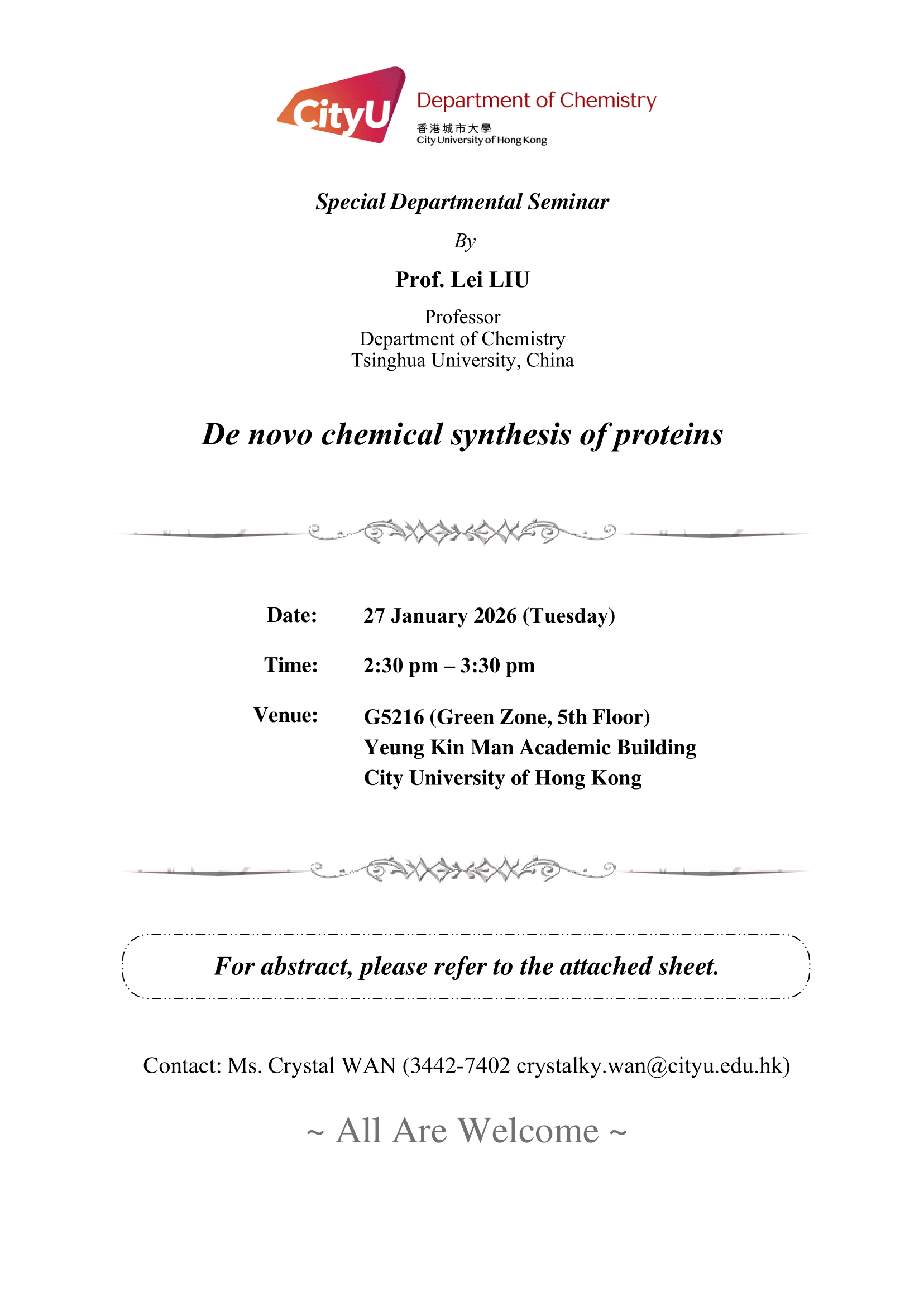
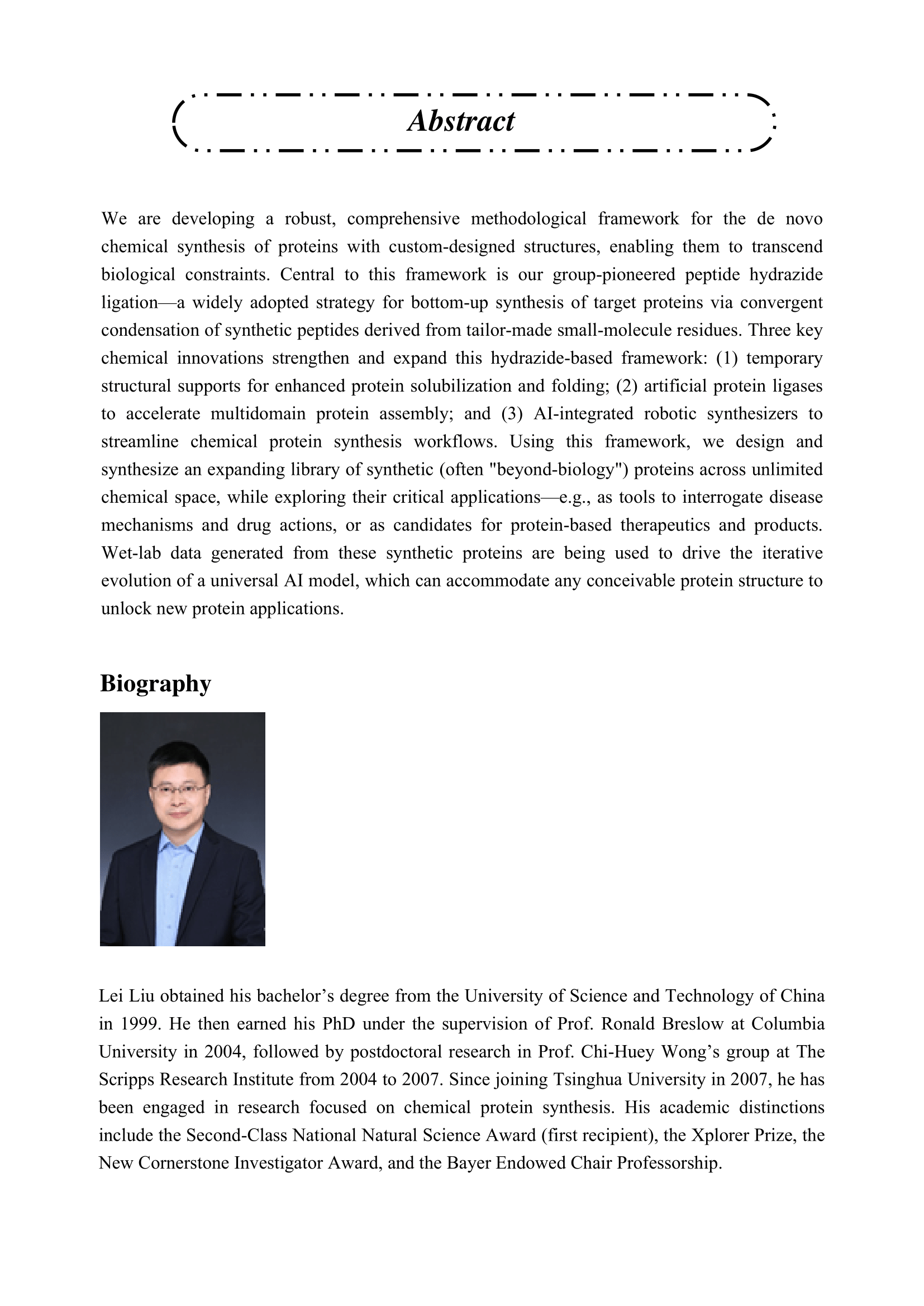
Professor Liu Lei hosted a seminar on de novo chemical protein synthesis at City University of Hong Kong. His lab at Tsinghua University has developed a comprehensive methodological framework that transcends biological constraints, enabling synthesis of custom-designed proteins up to 3,000 amino acids—covering 99.7% of all natural proteins. Three key innovations form this framework: (1) <strong>peptide hydrazide ligation</strong> for convergent synthesis without protecting groups; (2) <strong>reversible auxiliary strategies</strong> using charged or carbohydrate tags to prevent aggregation during synthesis; and (3) <strong>artificial ligase enzymes</strong> that catalyze protein assembly in denaturing conditions. These techniques unlock “beyond-biology” applications including mirror-image D-proteins, site-specifically modified therapeutic targets, and rapid drug candidate synthesis. This post explores the chemistry breakthroughs, pharmaceutical implications, and synergies with AI-driven drug discovery that make chemical protein synthesis a game-changer for biomedical research.</p>

<hr />

<p>Today I attended a lecture by Professor Liu Lei from Tsinghua University at City University of Hong Kong, and honestly, my mind is blown! 🤯 I thought proteins could only be made by cells, but Professor Liu’s team just proved that chemists can build <em>any</em> protein from scratch—even ones nature has never seen before.</p>

<p><img src="/images/blog/2026-01-27-seminar-poster-1.png" alt="Seminar Poster Abstract" /></p>

<p>The three game-changing breakthroughs:</p>

<ul>
  <li><strong>Peptide Hydrazide Ligation</strong> (Join protein pieces without the usual chemical headaches)</li>
  <li><strong>Reversible Auxiliary Strategies</strong> (Temporary “scaffolding” keeps proteins from clumping during synthesis)</li>
  <li><strong>Artificial Ligase Enzymes</strong> (Designer enzymes that work where natural ones fail)</li>
</ul>

<p>It felt like watching someone unlock a secret level in protein synthesis—going from “we can make small peptides” to “we can build 99.7% of all known proteins.” 🧬✨</p>

<p><img src="/images/blog/2026-01-27-seminar-poster-2.png" alt="Seminar Poster Biography" /></p>

<h2 id="-the-chemistry-revolution-breaking-the-rules-we-thought-were-unbreakable">📚 The Chemistry Revolution: Breaking the Rules We Thought Were Unbreakable</h2>

<h3 id="1-peptide-hydrazide-ligation--the-impossible-reaction-">1. Peptide Hydrazide Ligation | The “Impossible” Reaction 🔗</h3>

<p><strong>Core Breakthrough: Two Nucleophiles Can Form an Amide Bond</strong></p>

<p>Professor Liu started by challenging organic chemistry dogma. For decades, everyone “knew” you need an electrophile + nucleophile to make peptide bonds. But his team asked: what if we use <em>two nucleophiles</em> instead?</p>

<p>Traditional methods had three fatal flaws:</p>

<ul>
  <li><strong>Racemization</strong>: Your protein becomes a mixture of wrong stereoisomers</li>
  <li><strong>Hydrolysis</strong>: Water destroys your precious intermediate</li>
  <li><strong>Self-destruction</strong>: Protein electrophiles react with themselves, creating a purification nightmare</li>
</ul>

<p>The elegant solution? <strong>Peptide hydrazide chemistry</strong>:</p>

<ol>
  <li>Start with a peptide ending in -NHNH₂ (hydrazide)</li>
  <li>Add sodium nitrite (pH 2-3)—yes, the same stuff used in food preservation</li>
  <li>Add a cysteine-containing peptide (pH 7)</li>
  <li>Boom—you get a new amide bond with <em>zero</em> protecting groups needed</li>
</ol>

<p><strong>What does this unlock?</strong></p>

<ul>
  <li>🧪 <strong>Commercially available building blocks</strong>: You can literally buy 20-60 amino acid segments with hydrazides pre-installed</li>
  <li>🚀 <strong>One-pot synthesis</strong>: Add segments sequentially without purifying intermediates</li>
  <li>🎯 <strong>Any amino acid works</strong>: Natural, unnatural, D-amino acids, β-amino acids—total design freedom</li>
</ul>

<p>The most surprising part? The intermediate—acyl azide—was <em>supposed</em> to undergo Curtius rearrangement (that’s textbook organic chemistry). But in the presence of thiols, it converts to thioesters faster than the rearrangement can happen. Even reviewers initially didn’t believe this!</p>

<p>It’s like discovering that water can flow uphill under the right conditions—chemistry just doesn’t work the way we thought.</p>

<h3 id="2-reversible-auxiliary-strategies--the-scaffolding-trick-️">2. Reversible Auxiliary Strategies | The “Scaffolding” Trick 🏗️</h3>

<p><strong>Core Innovation: Temporary Helpers Prevent Disaster</strong></p>

<p>Once you get past 300 amino acids, a new enemy appears: <strong>protein aggregation</strong>. Professor Liu explained this with a brilliant analogy:</p>

<p><strong>Think of building a skyscraper</strong>. Ancient builders could only make small structures because they lacked scaffolding. Modern engineers use temporary supports during construction, then remove them once the building stands on its own.</p>

<p>Here’s the molecular problem:</p>

<ul>
  <li>Small proteins (&lt;100 amino acids): Hydrophobic residues mostly face outward → soluble during synthesis</li>
  <li>Large proteins (&gt;300 amino acids): Many hydrophobic residues buried inside → insoluble intermediates that crash out of solution like “gel-like solids”</li>
</ul>

<p><strong>The solution comes in two versions:</strong></p>

<table>
  <thead>
    <tr>
      <th>Strategy</th>
      <th>How It Works</th>
      <th>Best For</th>
    </tr>
  </thead>
  <tbody>
    <tr>
      <td><strong>Version 1.0: Positive Charges</strong></td>
      <td>Attach arginine-rich tags via cleavable linkers</td>
      <td>Proteins without excessive negative charges</td>
    </tr>
    <tr>
      <td><strong>Version 2.0: Carbohydrates</strong></td>
      <td>Install neutral sugar groups (glucose, lactose, etc.)</td>
      <td>Proteins that resist Version 1.0; also assists folding!</td>
    </tr>
  </tbody>
</table>

<p>The carbohydrate strategy had an unexpected bonus: Interleukin-5, a protein that <em>nobody</em> could refold in vitro before, folded with ~100% efficiency when temporarily glycosylated. The sugars acted like molecular chaperones!</p>

<p>With these strategies, the synthesis ceiling jumped from 300 → 600 amino acids, covering <strong>87% of all natural proteins</strong>.</p>

<h3 id="3-template-driven-ligation--artificial-ligases--conquering-the-final-frontier-">3. Template-Driven Ligation &amp; Artificial Ligases | Conquering the Final Frontier 🧬</h3>

<p><strong>Core Problem: When Proteins Get Too Big to React</strong></p>

<p>At 600+ amino acids, chemistry hits another wall. But this time, it’s not a solubility problem—it’s a <strong>conformational problem</strong>.</p>

<p><strong>Here’s the physics:</strong></p>

<ul>
  <li>Small peptides: The reactive N- and C-termini are always exposed to solution → fast reactions</li>
  <li>Giant proteins: The chain folds back on itself, burying the reactive sites → effective concentration drops to nearly zero</li>
</ul>

<p>Professor Liu described this as “soluble but unreactive”. Students would report: “The reaction just doesn’t happen, even though everything’s dissolved.”</p>

<p><strong>The paradigm shift:</strong> Stop relying on random collisions. Use <strong>template-driven catalysis</strong>.</p>

<p><strong>Three approaches emerged:</strong></p>

<ol>
  <li><strong>Split Intein Templates (BISIAL)</strong>: Natural protein-recognition domains bring the termini together, even in 6 M urea</li>
  <li><strong>Thioacetal Chemistry (TAL)</strong>: Chemical templates using aldehyde-thiol coupling—works even in harsh trifluoroacetic acid</li>
  <li><strong>Artificial Ligase Enzymes</strong>: The ultimate solution—evolved enzymes that work in denaturing conditions</li>
</ol>

<p>The artificial ligase (Mutant-51, developed through directed evolution) is genuinely impressive:</p>

<ul>
  <li><strong>92% conversion in 4 M urea</strong> (natural enzymes would be completely denatured)</li>
  <li><strong>Works at ultra-low concentrations</strong> (0.5 µM to 100 µM)</li>
  <li><strong>Joins 50+ kDa segments</strong> to create &gt;100 kDa proteins</li>
</ul>

<p>With this technology, they’ve now synthesized:</p>

<ul>
  <li><strong>Taq DNA polymerase</strong>: 856 amino acids, fully functional</li>
  <li><strong>UFD2</strong>: 2,824 amino acids—nearly 3,000!</li>
</ul>

<p><strong>The new ceiling: 3,000 amino acids → 99.7% of all proteins</strong>.</p>

<h2 id="-the-bigger-picture-why-this-matters-beyond-academic-curiosity">💡 The Bigger Picture: Why This Matters Beyond Academic Curiosity</h2>

<h3 id="1-expanding-natures-playbook-">1. Expanding Nature’s Playbook 🌌</h3>

<p>Professor Liu invoked R.B. Woodward’s philosophy: <em>“Organic chemistry has literally placed a new nature beside the old.”</em></p>

<p>Biological expression is limited to 20 canonical amino acids. Chemical synthesis unlocks:</p>

<ul>
  <li><strong>Mirror-image proteins</strong> (made from D-amino acids—completely resistant to biological degradation)</li>
  <li><strong>Cyclic proteins</strong> (no loose ends, ultra-stable)</li>
  <li><strong>Unnatural backbones</strong> (β-amino acids, exotic modifications)</li>
</ul>

<p>This isn’t just about copying nature—it’s about creating molecular structures that evolution never explored.</p>

<h3 id="2-precision-medicine-through-proteoform-engineering-">2. Precision Medicine Through Proteoform Engineering 🏥</h3>

<p>Here’s where it gets medically exciting. The same gene can produce dozens of different protein versions (proteoforms) through post-translational modifications:</p>

<ul>
  <li>Methylation</li>
  <li>Phosphorylation</li>
  <li>Ubiquitination</li>
  <li>Glycosylation</li>
</ul>

<p>Most diseases involve <em>specific modified versions</em>, not just “too much” or “too little” protein.</p>

<p><strong>The challenge:</strong> You can’t study what you can’t make. Cells produce mixtures; chemical synthesis gives you <em>exactly</em> the modified form you need.</p>

<p><strong>Breakthrough application: Molecular Glue Degraders</strong></p>

<p>Professor Liu’s team synthesized 366-amino-acid protein complexes that trap the <em>transient intermediates</em> of ubiquitination. This is like freezing a hummingbird mid-flight—these enzyme-substrate complexes exist for milliseconds before dissociating.</p>

<p>Using these synthetic tools, they:</p>

<ul>
  <li>Solved structures of 8 different molecular glue drugs (3 already approved: thalidomide, lenalidomide, pomalidomide)</li>
  <li>Explained why <strong>mezigdomide</strong> selectively degrades IKZF1/3 while <strong>eragidomide</strong> targets GSPT1, despite near-identical structures</li>
  <li>Discovered that a single side-chain difference determines whether a drug enters the “right” binding pocket</li>
</ul>

<p><strong>Real-world impact:</strong></p>

<ul>
  <li><strong>Tirzepatide</strong> (Eli Lilly’s blockbuster GLP-1/GIP dual agonist): Predicted $50 billion revenue in 2026—developed using hydrazide chemistry for rapid analog synthesis</li>
  <li><strong>Two molecules in Phase II clinical trials</strong>, including DSS1 for dry eye syndrome</li>
</ul>

<h3 id="3-the-ai-revolution-needs-chemistry-">3. The AI Revolution Needs Chemistry 🤖</h3>

<p>Here’s the most exciting synergy: Professor Liu collaborated with Tsinghua’s AI center to develop <strong>DrugCLIP</strong>—an algorithm that screens 500 million molecules against human proteins.</p>

<p><strong>The workflow:</strong></p>

<ol>
  <li>Chemical synthesis provides precise protein structures (including pockets never seen before)</li>
  <li>AI identifies which molecules from enormous databases might bind</li>
  <li>Synthetic chemistry rapidly tests predictions</li>
  <li>Success rate: ~15% hit at 10 µM potency for the free version</li>
</ol>

<p>They discovered TRIP12 ubiquitin ligase inhibitors <em>without any experimental screening</em>—just computational prediction validated by synthesis. Two compounds showed Kd values around 10-12 µM.</p>

<p>AI <em>designs</em>. Chemistry <em>delivers</em>. Together they unlock “unlimited structural space”.</p>

<h3 id="4-speed-as-a-strategic-advantage-">4. Speed as a Strategic Advantage ⚡</h3>

<p>In pharmaceutical development, <strong>time = billions of dollars</strong>.</p>

<table>
  <thead>
    <tr>
      <th>Method</th>
      <th>Time Required</th>
    </tr>
  </thead>
  <tbody>
    <tr>
      <td><strong>Chemical synthesis</strong></td>
      <td>Few days</td>
    </tr>
    <tr>
      <td><strong>Biological expression</strong></td>
      <td>Weeks</td>
    </tr>
  </tbody>
</table>

<p>For a company racing to file patents or enter clinical trials, hydrazide chemistry isn’t just faster—it’s the difference between winning and losing a market.</p>

<h2 id="-questions-that-linger-and-future-brainstorming">🤔 Questions That Linger (and Future Brainstorming)</h2>

<p>The seminar sparked several thoughts for neuroscience work:</p>

<p><strong>For Alzheimer’s Research:</strong></p>

<ul>
  <li>Could you synthesize <strong>site-specifically modified tau</strong> or <strong>amyloid-beta oligomers</strong> to study exactly which modifications drive toxicity?</li>
  <li>Professor Liu mentioned Professor Chong Liu at Shanghai Institute of Organic Chemistry does extensive work on misfolding inhibitors using hydrazide ligation</li>
</ul>

<p><strong>For Screening Campaigns:</strong></p>

<ul>
  <li>Synthetic alpha-synuclein with precise phosphorylation patterns (e.g., pS129) would be invaluable for high-throughput screening of aggregation inhibitors</li>
</ul>

<p><strong>Methodological Questions:</strong></p>

<ul>
  <li>Can molecular chaperones (like GroEL) assist folding of chemically synthesized proteins? <strong>Answer: Yes!</strong> Even D-amino acid proteins fold with GroEL assistance</li>
  <li>Could you couple chemical synthesis with computational models to validate predicted biomarker structures?</li>
</ul>

<h2 id="-final-thoughts-the-philosophy-of-building-vs-growing">🎤 Final Thoughts: The Philosophy of “Building” vs. “Growing”</h2>

<p>My biggest takeaway: <strong>The most powerful innovations come from questioning assumptions everyone else accepts</strong>.</p>

<p>For 120+ years (since Emil Fischer in the 1900s), protein chemistry assumed:</p>

<ul>
  <li>You need electrophiles to make amide bonds → <strong>Wrong</strong></li>
  <li>Proteins &gt;300 amino acids need protecting groups → <strong>Wrong</strong> (just use auxiliaries)</li>
  <li>Natural enzymes can’t work in denaturing conditions → <strong>Wrong</strong> (evolve artificial ones)</li>
</ul>

<p>Professor Liu’s research embodies what R.B. Woodward called “placing a new nature beside the old”. We’re no longer limited to the proteins that ribosomes can make. We can design molecules that:</p>

<ul>
  <li>Resist degradation (D-proteins)</li>
  <li>Target diseases with atomic precision (site-specific modifications)</li>
  <li>Function in ways evolution never imagined (unnatural backbones)</li>
</ul>

<p><strong>This isn’t just chemistry—it’s molecular architecture.</strong></p>

<hr />

<p><strong>This article is for you if:</strong></p>

<p>🧬 You think “you can only make what biology allows” and want to see those limits shattered<br />
💊 You’re interested in next-generation therapeutics based on precise protein engineering<br />
🤖 You want to understand how AI + chemistry creates a feedback loop for drug discovery<br />
🔬 You believe understanding disease mechanisms requires tools biology can’t provide</p>

<p><strong>Let’s discuss:</strong> If you could chemically synthesize <em>any</em> modified protein for your research, what would it be? For me—site-specifically phosphorylated alpha-synuclein to map exactly which modifications trigger Parkinson’s pathology. What’s yours? 💭</p>

<p><strong>P.S.</strong> The seminar Q&amp;A revealed something beautiful: Professor Liu admitted they didn’t predict all these challenges upfront. They hit the 300-amino-acid wall, developed auxiliaries, then hit the 600-amino-acid wall, realized it was conformational, then developed templates. <strong>Great science isn’t about having all the answers—it’s about having the persistence to solve each problem as it emerges.</strong> That’s real research wisdom. 🙏</p>

<hr />

<p><strong>Seminar Details:</strong></p>
<ul>
  <li><strong>Speaker:</strong> Professor Lei Liu, Department of Chemistry, Tsinghua University</li>
  <li><strong>Title:</strong> De novo chemical synthesis of proteins</li>
  <li><strong>Date:</strong> January 27, 2026</li>
  <li><strong>Venue:</strong> G5216 (Green Zone, 5th Floor), Yeung Kin Man Academic Building, City University of Hong Kong</li>
</ul>]]></content><author><name>CHENG, Wan Kiu Winkey</name><email>wkwcheng4-c@my.cityu.edu.hk</email></author><category term="protein-synthesis" /><category term="chemical-biology" /><category term="drug-discovery" /><category term="seminar-notes" /><category term="biomedical-engineering" /><summary type="html"><![CDATA[🎯 The Big Reveal Up Front: Chemistry Just Leveled Up! Professor Liu Lei hosted a seminar on de novo chemical protein synthesis at City University of Hong Kong. His lab at Tsinghua University has developed a comprehensive methodological framework that transcends biological constraints, enabling synthesis of custom-designed proteins up to 3,000 amino acids—covering 99.7% of all natural proteins. Three key innovations form this framework: (1) peptide hydrazide ligation for convergent synthesis without protecting groups; (2) reversible auxiliary strategies using charged or carbohydrate tags to prevent aggregation during synthesis; and (3) artificial ligase enzymes that catalyze protein assembly in denaturing conditions. These techniques unlock “beyond-biology” applications including mirror-image D-proteins, site-specifically modified therapeutic targets, and rapid drug candidate synthesis. This post explores the chemistry breakthroughs, pharmaceutical implications, and synergies with AI-driven drug discovery that make chemical protein synthesis a game-changer for biomedical research.]]></summary></entry><entry><title type="html">生物醫學系研討會：看大神如何把微流控變成「懶人科技」</title><link href="https://www.winkeylab.work/posts/2026/01/david-juncker-microfluidics/" rel="alternate" type="text/html" title="生物醫學系研討會：看大神如何把微流控變成「懶人科技」" /><published>2026-01-13T00:00:00+08:00</published><updated>2026-01-13T00:00:00+08:00</updated><id>https://www.winkeylab.work/posts/2026/01/david-juncker-microfluidics-seminar</id><content type="html" xml:base="https://www.winkeylab.work/posts/2026/01/david-juncker-microfluidics/"><![CDATA[<p><strong>Summary:</strong><br />
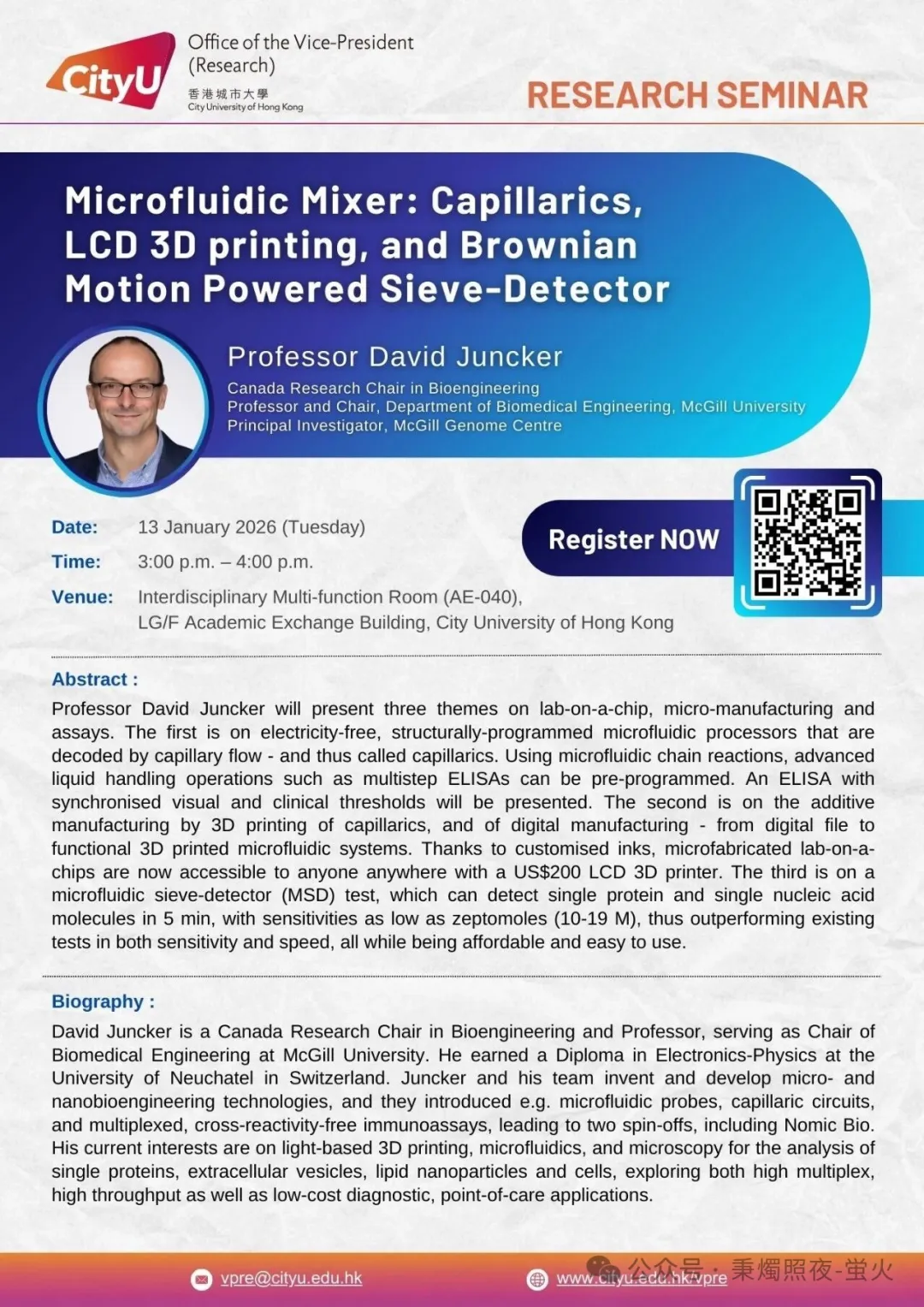
Professor David Juncker from McGill University presented an inspiring seminar on minimalist microfluidics technologies. Three groundbreaking innovations were presented: (1) <strong>Capillary microfluidics</strong> - using natural capillary action instead of pumps for fluid manipulation, enabling battery-free diagnostics in remote areas; (2) <strong>LCD 3D printing</strong> - democratizing microfluidic chip fabrication with consumer-grade 3D printers (25-50μm resolution), reducing costs from thousands to tens of dollars and production time from days to hours; (3) <strong>Brownian motion detector</strong> - leveraging molecular thermal motion for ultra-sensitive, zero-energy biosensing. The talk emphasizes “elegant simplicity” in engineering design - harnessing natural physical phenomena rather than fighting them, making advanced diagnostics accessible worldwide.</p>

<hr />

<p><img src="/images/blog/2026-01-13-seminar-poster.png" alt="Professor Juncker's presentation" /></p>

<h1 id="生物醫學系研討會看大神如何把微流控變成懶人科技">生物醫學系研討會：看大神如何把微流控變成「懶人科技」</h1>

<p>🎯 <strong>先說重點：今天開眼了！</strong></p>

<p>剛聽完麥吉爾大學David Juncker教授的講座——好傢伙，原來科研還能這麼玩！🤯 教授團隊的三項黑科技，簡直是把「極簡主義」貫徹到了微流控領域：</p>

<ul>
  <li>毛細微流控（液體自己會跑，不用電）</li>
  <li>LCD 3D列印晶片（實驗室裝備，網購就能造）</li>
  <li>布朗運動檢測器（分子自己「跳」出結果）</li>
</ul>

<p>感覺像是看了一場「如何用最少零件造最聰明設備」的魔術秀。🪄</p>

<h2 id="-技術拆解原來原理可以這麼香">📚 技術拆解：原來原理可以這麼「香」</h2>

<h3 id="1-毛細微流控物理系的躺平哲學">1. 毛細微流控｜物理系的「躺平哲學」💧</h3>

<p><strong>核心絕招：讓液體自己幹活</strong></p>

<p>教授一上來就顛覆認知——原來不用泵、不用電，液體也能在晶片裡完成混合、反應、檢測全套流程！原理就像毛筆蘸墨，墨跡自動順著筆尖往上走，純靠材料自身的毛細作用。</p>

<p>這對實際應用意味著什麼？</p>

<ul>
  <li>🏔️ <strong>野外也能用</strong>：偏遠山區、災區現場，沒電照常工作</li>
  <li>💰 <strong>成本大跳水</strong>：省去所有動力部件，設備價格親民</li>
  <li>🤖 <strong>自帶「流程大腦」</strong>：液體按設計路線自主完成多步驟操作</li>
</ul>

<p>最精妙的是那個微流控混合器——通過設計迷宮般的微通道，讓液體流經時自動攪勻。這就好比讓黃河水自己在家門口拐出九曲十八彎，泥沙自然沉澱，根本不用額外攪拌。</p>

<h3 id="2-lcd-3d列印實驗室的拼多多革命-️">2. LCD 3D列印｜實驗室的「拼多多革命」 🖨️</h3>

<p><strong>核心突破：萬元設備幹百萬的活</strong></p>

<p>傳統微流控制造？那得進超淨間、用光刻機，燒錢又耗時。但Juncker教授團隊說：別那麼複雜，用消費級3D印表機就行！</p>

<p><strong>現實對比表：</strong></p>

<table>
  <thead>
    <tr>
      <th>傳統方法</th>
      <th>LCD 3D列印</th>
    </tr>
  </thead>
  <tbody>
    <tr>
      <td>需超淨車間</td>
      <td>普通實驗室就行</td>
    </tr>
    <tr>
      <td>耗時數天</td>
      <td>1-2小時搞定</td>
    </tr>
    <tr>
      <td>成本高昂</td>
      <td>耗材幾十塊錢</td>
    </tr>
    <tr>
      <td>改動困難</td>
      <td>設計隨改隨打</td>
    </tr>
  </tbody>
</table>

<p>而且他們做到了<strong>25-50微米精度</strong>——什麼概念？一根頭髮絲直徑的1/3，微流控應用綽綽有餘。</p>

<p>這帶來的最大改變是：讓沒有雄厚資金的小實驗室、甚至本科生，都能參與微流控創新。科研界的「草根逆襲」劇本，正在上演。🚀</p>

<h3 id="3-布朗運動檢測器給分子辦廣場舞大賽-️">3. 布朗運動檢測器｜給分子辦「廣場舞大賽」 ⚛️</h3>

<p><strong>核心創意：把噪聲變信號</strong></p>

<p>這部分最震撼——連檢測都不用電了！</p>

<p><strong>工作原理（試聯想）：</strong></p>

<ol>
  <li>所有分子都在「跳廣場舞」（布朗運動就是隨機抖動）</li>
  <li>小分子跳得快，像靈活的大爺大媽</li>
  <li>大分子動作慢，像穿著羽絨服跳舞</li>
  <li>當目標分子（比如病毒蛋白）結合上抗體，瞬間「胖成球」，動作變慢</li>
  <li>設計奈米篩網：讓靈活的「舞者」通過，攔住笨重的「組合」</li>
</ol>

<p>結果？<strong>靈敏度提升100倍</strong>，還零能耗——全靠室溫下的分子自發運動。</p>

<p>這就像在春運火車站，不設檢票員，只修特殊通道——抱小孩的、拎大行李的自然走得慢，輕鬆區分開來。</p>

<h2 id="-啟發科研原來可以這麼接地氣">💡 啟發：科研原來可以這麼「接地氣」</h2>

<h3 id="1-大道至簡最高級的是不用力-">1. 大道至簡，最高級的是「不用力」 🌊</h3>

<p>教授的三大技術有個共同哲學：<strong>借力自然，而非對抗自然</strong>。毛細作用、分子熱運動、光固化原理——都是自然界現成的「免費勞動力」。這讓人想起中國山水畫的留白智慧：最妙處往往是不著筆墨的地方。</p>

<h3 id="2-科研大眾化人人可參與-">2. 科研大眾化，人人可參與 👐</h3>

<p>LCD 3D列印技術降低的不僅是成本，更是創新門檻。就像智能手機讓每個人都能攝影一樣，這項技術讓更多「民間高手」能參與微流控創新。未來診斷設備的「開源社區」，或許就在眼前。</p>

<h3 id="3-交叉思維拆掉學科的牆-">3. 交叉思維，拆掉學科的牆 🧱</h3>

<p>這個項目融合物理、化學、生物、工程——像極了一桌精彩的融合菜。教授用物理原理解決生物檢測難題，用工程思維優化製造流程。提醒我們：真正的高手，都不只守著自己的一畝三分地。</p>

<h3 id="4-落地為王科研要有煙火氣-">4. 落地為王，科研要有「煙火氣」 🏥</h3>

<p>最打動人的是，每一項技術都有明確的醫療應用場景：偏遠地區診斷、家庭健康監測、突發疫情快檢……好的技術，應該像氧氣一樣——需要時感受不到它的存在，卻時時刻刻在守護生命。</p>

<h2 id="-思考時間這些技術還能怎麼玩">🤔 思考時間：這些技術還能怎麼玩？</h2>

<p>聽著講座，我忍不住開起腦洞：</p>

<p><strong>神經科學版：</strong></p>
<ul>
  <li>用毛細微流控做<strong>攜帶式神經遞質檢測筆</strong>，隨時測多巴胺水平</li>
  <li>布朗運動檢測器改良後，或許能<strong>即時監測腦脊液標誌物</strong>，預警阿茲海默症</li>
</ul>

<p><strong>更酷的應用設想：</strong></p>
<ul>
  <li><strong>太空站健康監測</strong>：零重力環境下，無需泵的毛細系統優勢盡顯</li>
  <li><strong>家用健康「便利貼」</strong>：像創可貼一樣貼上，自動採血、分析、出結果</li>
</ul>

<h2 id="-結語">🎤 結語</h2>

<p>這場講座給我的最大觸動是：<strong>頂級創新往往不複雜，只是想到了別人沒想到的角度</strong>。就像用毛細現象替代機械泵——不是做不到，而是沒去想。</p>

<p>教授的團隊正在證明：<strong>最優雅的解決方案，通常是最省力的那個</strong>。這不僅是技術選擇，更是一種思維方式——無論是科研還是生活，或許我們都該學會「借力使力」，與規律共舞。</p>

<hr />

<p><strong>本文特別適合以下朋友閱讀：</strong></p>

<p>🔬 覺得科研太高冷，想看看「煙火氣」創新的你<br />
💡 正在尋找交叉學科靈感的你<br />
🚀 相信技術應該普惠大眾的你</p>

<p><strong>轉發提示：</strong> 如果你也認為「好技術應該像自來水一樣隨時可得」，歡迎分享這篇「科研界的清涼劑」~ 💦</p>

<p><strong>互動時間：</strong> 你覺得「零能耗診斷設備」最先會在哪個場景普及？歡迎留言區聊聊！</p>

<hr />

<p><em>Seminar Speaker: Prof. David Juncker, McGill University</em><br />
<em>Date: January 13, 2026</em><br />
<em>Location: City University of Hong Kong, Department of Biomedical Sciences</em></p>]]></content><author><name>CHENG, Wan Kiu Winkey</name><email>wkwcheng4-c@my.cityu.edu.hk</email></author><category term="biomedical-engineering" /><category term="microfluidics" /><category term="seminar-notes" /><category term="innovation" /><category term="capillary-microfluidics" /><category term="3d-printing" /><category term="biosensors" /><summary type="html"><![CDATA[Summary: Professor David Juncker from McGill University presented an inspiring seminar on minimalist microfluidics technologies. Three groundbreaking innovations were presented: (1) Capillary microfluidics - using natural capillary action instead of pumps for fluid manipulation, enabling battery-free diagnostics in remote areas; (2) LCD 3D printing - democratizing microfluidic chip fabrication with consumer-grade 3D printers (25-50μm resolution), reducing costs from thousands to tens of dollars and production time from days to hours; (3) Brownian motion detector - leveraging molecular thermal motion for ultra-sensitive, zero-energy biosensing. The talk emphasizes “elegant simplicity” in engineering design - harnessing natural physical phenomena rather than fighting them, making advanced diagnostics accessible worldwide.]]></summary></entry></feed>